
Office Refurbishment Furniture: Reworking and Resizing What You Already Own
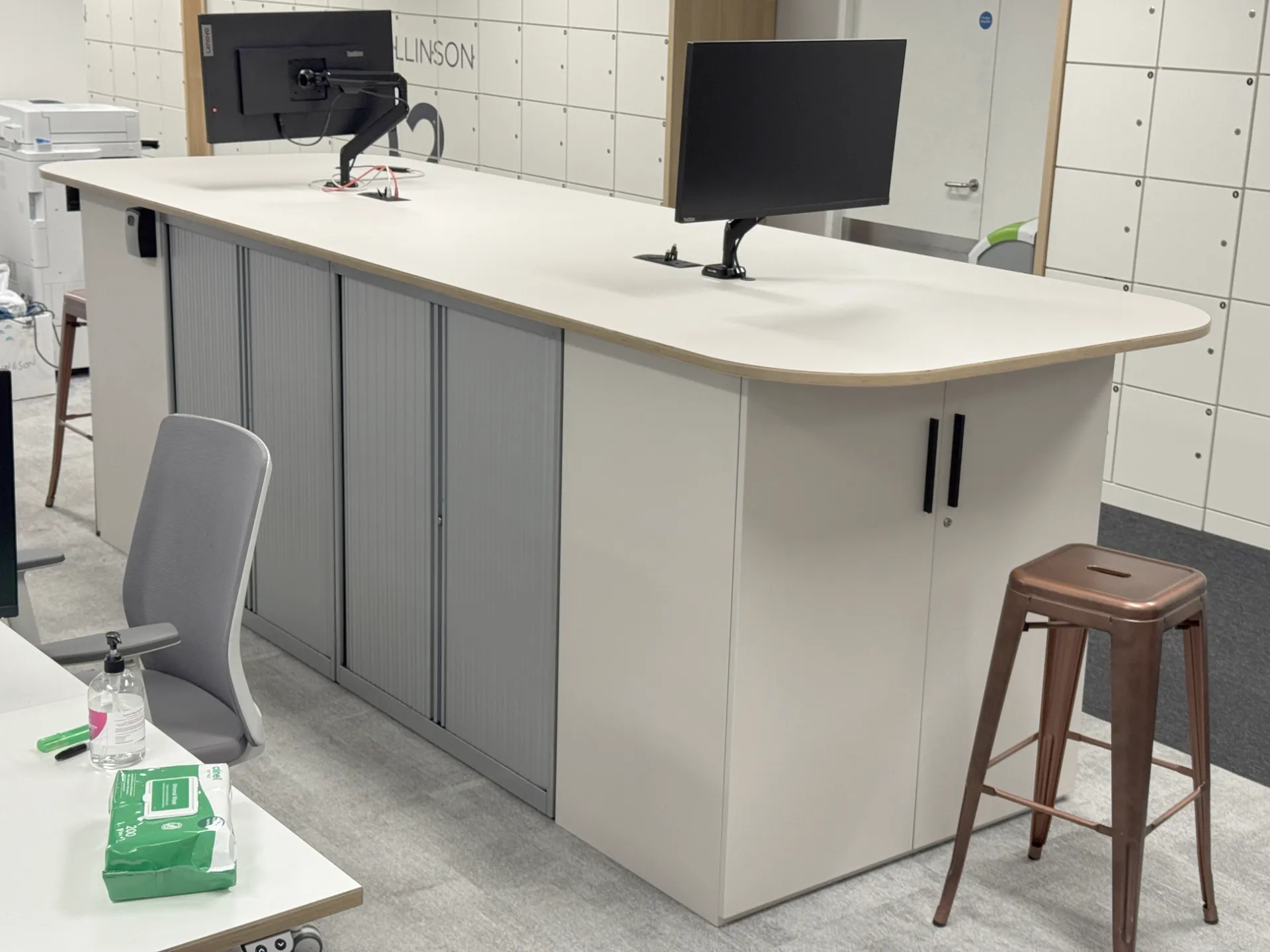
When an office is being refurbished or reconfigured, the default assumption is often that the furniture has to go too. In practice, a good proportion of what you already own can be reworked, resized and re-finished to fit the new layout — usually for less money, with a shorter lead time, and a far smaller environmental footprint than buying everything new. This guide walks through what is worth keeping, what can realistically be changed, and how the design-and-build process works.
Why reworking often beats buying new
Replacing every desk, cabinet and table in a refurbishment is rarely the most sensible option. Reworking existing pieces tends to win on several fronts at once:
- Cost. Re-topping a sound desk frame or re-finishing a run of storage almost always costs less than a like-for-like replacement, because you are paying for the change rather than the whole item.
- Lead time. Adapting what you have can move faster than ordering new furniture, which may carry manufacturing and shipping lead times measured in weeks or months.
- Sustainability. Keeping a steel frame or a carcass in use avoids the embodied carbon of making a new one and keeps usable material out of skips. We cover this in more depth in our guide to sustainable, reworked office furniture.
- Matching an existing scheme. If you are only changing part of the floor, reworking lets you match finishes, heights and detailing to furniture that is staying — something off-the-shelf ranges struggle to do.
- Familiarity. Staff already know how their storage and desks work. Adapting rather than replacing reduces disruption.
None of this means you should keep everything. The point is to make a deliberate decision rather than defaulting to a full replacement.
What can actually be reworked
More than most people expect. The frames, carcasses and structural elements of commercial furniture are often the most durable parts, while the visible surfaces are what date or wear. Common reworking jobs include:
- Re-topping desk frames. Sound height-adjustable or fixed frames can take new tops in a fresh colour, finish or material, instantly updating the look.
- Resizing desks and tables. Cutting down or extending tops to suit a denser or more generous new layout, or to fit awkward floor plates and columns.
- Re-finishing. Repainting metalwork, re-laminating or refacing surfaces, and refreshing edges so older pieces sit comfortably alongside new ones.
- Adapting storage. Reconfiguring pedestals, cupboards and credenzas; changing doors, fronts or handles; repurposing units as planters or caddies.
- Lockers and shrouds. Adding bespoke shrouds, tops and end panels to tie a bank of lockers into the new scheme, or adapting locker banks for agile working.
- Power and cable management. Retrofitting grommets, cable trays, under-desk baskets and power modules to bring older desks up to current expectations.
- Breakout and meeting pieces. Reworking tired tables into breakout tables, or combining parts from several redundant items into something new.
If a desk is being physically relocated as part of an office move, our guide on resizing and reusing desks when you move office goes into the move-specific logistics.
How to assess what is worth keeping
Before committing either way, it helps to audit the existing furniture honestly. A quick framework:
- Inventory what you have. Count and photograph each type — desks, frames, storage, tables, lockers — and note quantities, dimensions and finishes.
- Check structural condition. Are frames straight and stable? Are carcasses solid? Structural soundness matters far more than surface wear, which is usually fixable.
- Assess fit against the new layout. Will the pieces work at the new desk pitch, in the new zones, and around the building's fixed points?
- Weigh the rework cost against new. For each category, estimate roughly what adapting would involve versus replacing. Some items are clearly worth keeping; others are tired or non-standard enough that new makes more sense.
- Flag anything mismatched. Where you are blending old and new, identify the finishes and heights that need to be matched so nothing looks like an afterthought.
You do not need to do this alone — assessing what is viable, and pricing the options, is part of what a design-and-build partner brings to a refurbishment.
The design-and-build process
Reworking furniture is a design job as much as a making job, because the result has to fit a specific space and sit alongside whatever is staying. A typical sequence looks like this:
- Brief and site visit. Understanding the new layout, the look you are after, the budget and the timeline — and seeing the existing furniture in situ.
- Survey and assessment. Measuring frames and units, checking condition, and confirming what can be reworked versus replaced.
- Design and finishes. Drawings or visuals for the reworked pieces, with finish, colour and detailing options chosen to match the wider scheme.
- Sign-off and making. Once the design is agreed, the work is carried out — re-topping, resizing, re-finishing, fabricating new components and shrouds. We design in London and make through a vetted UK network.
- Delivery and install. Fitting and installing across London and the UK, ideally phased around your occupation so disruption is kept down.
Lead times depend entirely on scope, but well-defined reworking jobs typically run a few weeks from sign-off. You can see the full scope of what is possible on our custom design and build page.
When new bespoke or a ready-made range is the better call
Reworking is not always the answer. It makes sense to look at new when:
- The existing frames or carcasses are genuinely worn out, damaged or structurally unsound.
- The pieces are so non-standard that adapting them costs as much as replacing.
- You need a large quantity of matching items and have little existing stock to build on.
- The new use is fundamentally different from the old — for example, moving from fixed desks to agile settings.
In those cases you have two routes. A new bespoke piece is right where the requirement is genuinely specific — a particular footprint, a one-off boardroom table, fitted storage around an awkward wall. A ready-made range is the pragmatic choice where you simply need good, repeatable desking at volume: our Recon clip-together desks, for instance, are designed for fast deployment and easy reconfiguration later. In most real refurbishments the best answer is a blend — rework what is sound, add new bespoke where it counts, and fill the gaps with a ready-made range.
Frequently asked questions
Often, yes — but not always. Re-topping a sound desk frame or re-finishing storage usually costs less than a like-for-like replacement, because you are paying for the change rather than the whole item. The saving is biggest where the structure is durable and only the surfaces have dated. Where frames are worn out or highly non-standard, new can work out similar or better.
It varies hugely with what you own and what state it is in, so it is not something to promise upfront. The honest answer comes from an audit: counting and checking the pieces, testing structural condition, and comparing the rework cost against new for each category. Frames, carcasses and tables tend to be the most reusable; heavily worn or very bespoke items less so.
Yes — matching is one of the main reasons to rework rather than replace. Finishes, colours, edge details and heights can be specified to sit alongside furniture that is staying, so old and new read as one scheme. This is much harder to achieve with off-the-shelf ranges, which come in fixed finishes and sizes.
It depends entirely on scope and quantity, so treat any figure as general guidance. Well-defined jobs — re-topping a run of desks, re-finishing storage, adding shrouds — typically run a few weeks from design sign-off. Larger or more complex programmes take longer. Reworking is usually quicker than ordering new furniture, which can carry longer manufacturing and shipping lead times.
In most cases, yes. Grommets, under-desk cable trays and baskets, and power modules can be retrofitted to sound desks to bring them up to current expectations. It is one of the most common and cost-effective parts of a refurbishment, because it modernises how a desk works without replacing it.
No. We work directly with end-user businesses — facilities and office managers, and business owners — and also with dealers, designers and resellers. For a refurbishment, that means we can either manage the furniture workstream end to end or slot in alongside a designer or fit-out contractor as the maker.