
Moving Office? How to Resize and Reuse Your Existing Desks
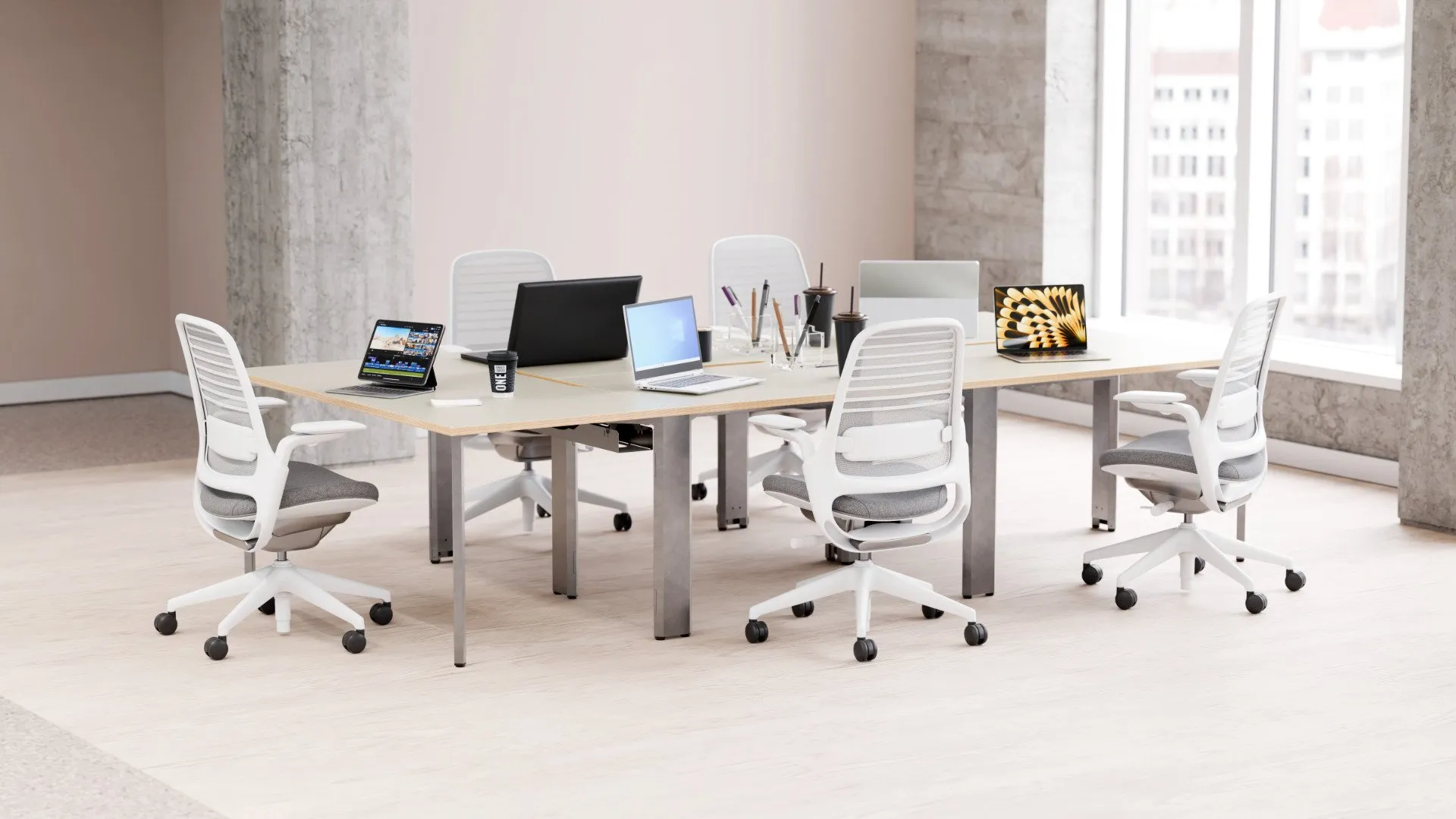
Relocating is the moment most companies assume they have to buy a whole new desk system. In practice, the desks you already own are often perfectly serviceable — they just don't fit the new floorplan as-is. Resizing, re-topping and reconfiguring what you have is usually faster, cheaper and far less wasteful than starting from scratch. Here's how to approach it.
Why desks rarely fit a new floorplan as-is
The frame and tops you have were specified for a different building. A new space changes almost every variable that governs how desks sit:
- Different column grid and wall lines. A bank that ran neatly along a wall in the old office might foul a structural column or a riser in the new one.
- Different bay widths. A run sized for 1,400mm positions may need 1,200mm or 1,600mm to hit the right headcount per zone.
- New circulation and fire routes. Desk runs often have to shorten or rotate to keep gangways and means of escape compliant.
- Power and data in new places. Floor boxes and dado trunking rarely land where they did before, so cable routes — and therefore desk orientation — change.
- A different headcount target. Most moves come with a brief to fit more (or fewer) people, or to add collaboration space, which means adding or removing positions from existing banks.
None of this means the desks are obsolete. It usually means the tops, the way banks are joined, and the cable management need adjusting — not the whole asset.
What can actually be done to existing desks
More than most people expect. A good furniture maker can rework what you own rather than replace it. Typical options include:
- Resizing tops. Cutting down oversized tops, or re-edging them to new dimensions, so a 1,600mm run becomes 1,400mm (or vice versa with new tops on the same frames).
- Re-topping tired frames. If the legs and beams are sound but the surfaces are scratched, chipped or dated, fitting fresh tops gives you an effectively new desk at a fraction of the cost.
- Reconfiguring banks. Splitting a six-person bench into two threes, turning back-to-back runs into single-sided pods, or merging loose desks into a tidy bank.
- Adding or removing positions. Extending a frame to take an extra seat, or stripping positions out to free up breakout space.
- New cable management. Adding cable trays, umbilicals, grommets and modesty panels to suit the new floor boxes — often the single biggest practical headache in a move.
- Matching finishes. Powder-coating frames to a consistent colour and specifying tops that blend old and new, so a reworked floor reads as one coherent scheme rather than a patchwork.
This is exactly the kind of work covered by our reworking service: taking the systems you already own and resizing, re-topping or reconfiguring them to suit the new space. Where it makes sense to mix in new positions, a modular system like our Recon click-together desks can sit alongside reworked frames and be reconfigured again the next time you move.
How to audit what you have before the move
Don't make decisions on memory. A short, honest audit tells you what's worth keeping and feeds straight into the relocation plan.
- Count and categorise. Walk the floor and log every desk: type, frame condition, top condition and current dimensions. Photograph anything damaged.
- Record the real sizes. Measure tops and frame footprints rather than trusting the original order. Desks get swapped, cut and mixed over the years.
- Note what's adjustable. Identify which frames are height-adjustable, which are fixed, and which can be extended. This shapes what can be reused where.
- Map against the new plan. Overlay your kept desks onto the new floorplan (your designer or fit-out contractor can help) to see what fits, what needs resizing and where the gaps are.
- Flag the cabling reality. Mark where new floor boxes and trunking will land, so you can spec the right cable management before, not after, the desks land.
- Decide keep / rework / replace. Sort every item into one of three piles. Most companies are surprised how much falls into "rework".
A clear inventory also makes quoting far quicker — a maker can price the rework accurately when they can see exactly what they're working with.
Logistics and timing around a move
Reworking desks during a relocation is mostly a sequencing problem. Get the order right and it's painless.
- Start early. Brief the rework at least a few weeks before the move, ideally as soon as the new plan is signed off. Resizing and re-topping take production time.
- Decide where the work happens. Some reworking is done off-site (tops cut and finished in a workshop, then delivered to the new building); some is fitted on installation day. Tops that need cutting or re-finishing are usually best done off-site.
- Coordinate with the wider fit-out. Desks should land after flooring, power and data are in, but in time for your IT and AV teams to set up. It's the same coordination logic as any office refurbishment — furniture is one of the last trades in.
- Plan the dead time. If desks leave the old site to be reworked, make sure staff have somewhere to work in the gap, or stage the move in phases.
- Keep a small buffer of spares. Hold back a few reworked positions for snagging and last-minute headcount changes.
A maker who designs, manufactures and installs can usually take the whole rework off your plate — survey, resize, finish, deliver and install to the new plan — which removes a lot of the coordination risk.
The cost and sustainability upside
The case for reworking is rarely just sentimental. It's commercial and environmental at once.
- Lower spend. Re-topping or resizing existing frames typically costs a fraction of buying equivalent new desks, because you're paying for adaptation and finishing rather than the whole product.
- Less embodied carbon and waste. Keeping sound steel frames in service avoids the carbon of new manufacture and the very real problem of office furniture going to landfill during moves.
- A stronger sustainability story. Reuse is concrete evidence for ESG and B Corp reporting — far easier to stand behind than vague claims.
- Consistency on your terms. Re-finishing lets you bring mismatched legacy desks up to one standard, so the new office looks deliberate rather than inherited.
Exact savings depend on the condition of what you have and how much reconfiguration is involved, but reuse almost always beats replacement on both cost and carbon when the frames are sound.
Frequently asked questions
In most cases, yes — provided the frames are structurally sound. You're paying to resize, re-top, re-finish and reconfigure rather than for an entire new product, so the saving can be significant. The exception is badly corroded or obsolete frames, where replacement may be the sensible call. An audit tells you which desks are worth keeping before you commit.
It depends on scope, but plan for a few weeks from sign-off rather than days. Resizing tops, applying new finishes and powder-coating frames all need production time, and that work is best done before the desks arrive in the new building. Briefing the rework as soon as the new floorplan is confirmed gives you the most comfortable runway.
Usually, yes. Frames can be powder-coated to a consistent colour and tops specified to blend legacy and new desks, so a reworked floor reads as one scheme. Exact colour and laminate matches aren't always possible with discontinued ranges, but a sensible specification can make a mixed floor look entirely deliberate.
Audit them. Count every desk, record real top and frame sizes, photograph any damage, and sort each into keep, rework or replace. Map the kept desks onto the new floorplan and note where new power and data will land. That inventory drives accurate rework quotes and a much smoother relocation.
Yes. Frames can often be extended to take an extra seat, or positions stripped out to free up breakout or collaboration space. Banks can be split, merged or reorientated to suit the new layout and headcount. Where you need genuinely flexible additions, a modular click-together system can sit alongside the reworked frames.
Reworking is most painless when the same team surveys, adapts, delivers and installs. That removes the coordination gap between a separate supplier and your fit-out, and means the desks land on the new plan, in the right finish, ready for IT to connect. Reframe designs, makes and installs across London and the UK.