
Locker Shroud Kits: Refreshing Existing Lockers Without Replacing Them
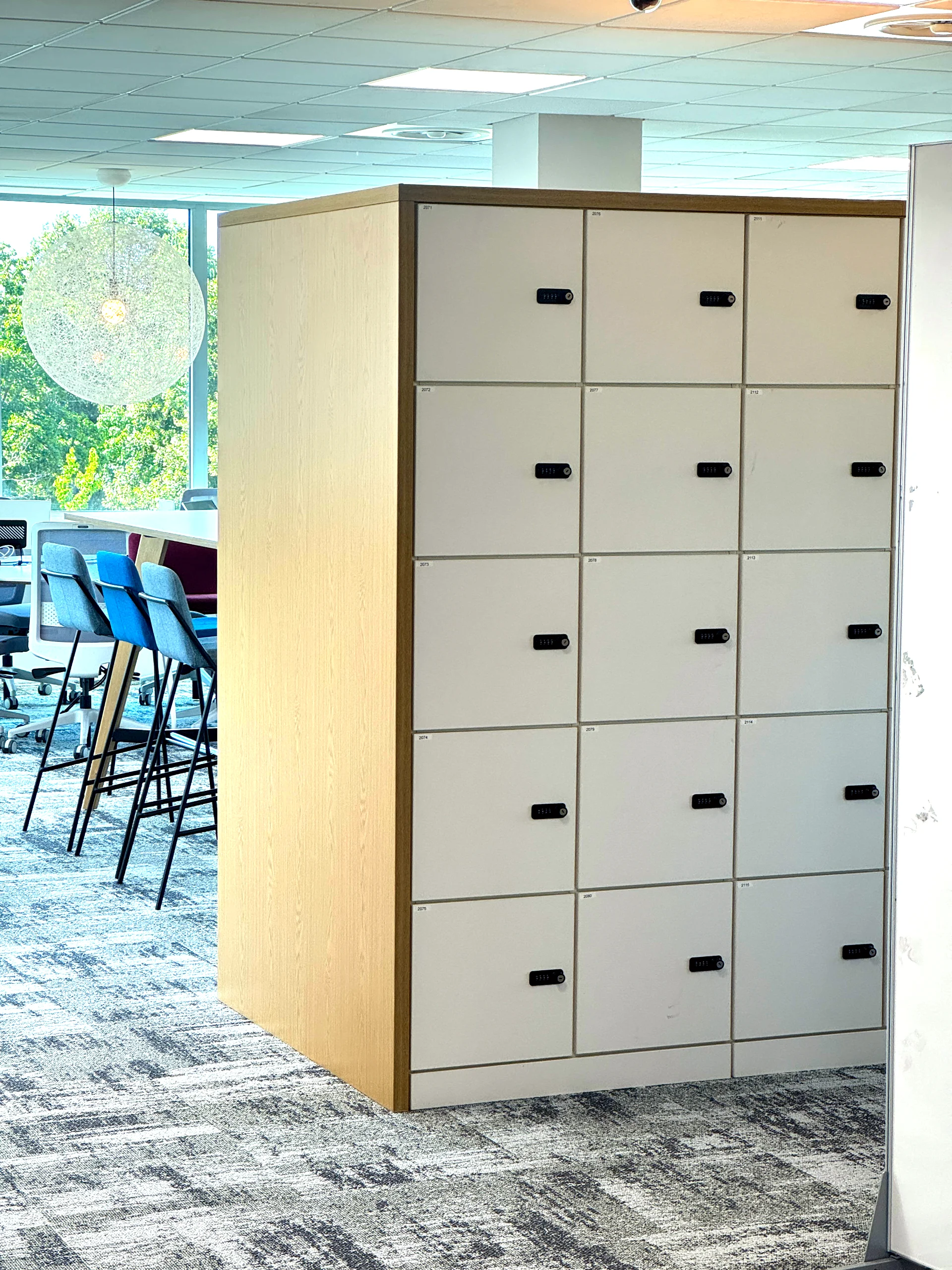
If your office lockers still lock, still hold up, and still do the job — but look tired or clash with a new scheme — you don't necessarily need to rip them out. A locker shroud kit lets you reface what's already there: bespoke panels that fit over the existing carcass to give it a fresh finish, a fraction of the waste, and usually a fraction of the disruption. This guide explains what shroud kits are, when they make sense, how they're designed to fit, and how they stack up against full replacement.
What a locker shroud kit actually is
A shroud kit is a set of made-to-measure panels and trims that clad the visible surfaces of an existing locker bank — the ends, the front face between and around the doors, the plinth or base, and often a new top or cornice. The steel or timber carcass underneath stays in place. The doors might be reused, repainted, or replaced; the locks and mechanisms can usually carry on as they are.
Think of it as a tailored skin rather than a new piece of furniture:
- End panels and pilasters to tidy the sides and the gaps between runs.
- Front cladding to update the face the room actually sees.
- A new top or cornice to cap the bank cleanly and hide an uneven existing top.
- Plinths and infills to deal with skirting, pipework and floor gaps.
Because every locker bank is a slightly different size — and older units rarely match modern modular dimensions — a shroud is essentially a small piece of bespoke design and build. It's measured and made for your specific run, not pulled off a shelf.
When a shroud makes sense (and when it doesn't)
Refacing is the right call when the bones are good but the look isn't. The carcass is the expensive, heavy, structural part; if that's sound, you're mostly paying to change appearance.
A shroud kit tends to make sense when:
- the lockers are structurally sound — doors close, locks work, no significant rust or damage;
- you're refreshing on a budget and full replacement is hard to justify;
- you need the lockers to match a new scheme — a rebrand, a refurbished floor, a change of colour palette;
- sustainability matters, and you'd rather not send a working steel bank to landfill;
- the units are in an awkward run or alcove where standard replacement lockers wouldn't fit neatly anyway.
It's the wrong call when the carcasses are corroded, the doors are bent or failing, the configuration no longer suits how the team works (you've gone hybrid and need fewer, larger lockers), or you're changing the footprint entirely. In those cases, replacement — or a mix of new units and refaced ones — is the honest answer. A good maker will tell you which camp you're in before quoting.
How shroud kits are designed and measured to fit
The whole point of a shroud is that it disappears into the existing run, so measuring is where the work is. Old lockers are rarely square, rarely a round number, and often sit against walls, columns or pipework that the panels have to work around.
A typical process looks like this:
- Survey — someone measures the existing bank on site: overall dimensions, door positions, gaps, out-of-square, and any obstructions like skirting, radiators or cable trays.
- Design — drawings set out how the panels wrap the carcass, how joints fall, and how the new top and plinth resolve against the floor and wall.
- Finish selection — you choose the material and colour (more on that below), and we confirm how doors are handled — reuse, repaint or replace.
- Manufacture — panels are cut and finished to the survey dimensions through a vetted UK network.
- Install — the cladding is fitted over the carcass on site, scribed to walls where needed, with minimal disruption to the floor.
Measuring from the actual units rather than from a catalogue spec is what stops a refaced bank looking like a box with panels leaning against it. The same precise-fit thinking applies across fitted office storage generally — it's the fit that makes it read as built-in rather than bolted-on.
Finish options
This is where a shroud earns its keep, because the finish is the entire reason you're doing it. Common options include:
- Melamine-faced board (MFC) in a wide range of woodgrains and solid colours — hard-wearing and cost-effective.
- Real-wood veneer or solid timber edges where you want a warmer, more premium feel.
- Laminate and Fenix surfaces for a contemporary, low-sheen, fingerprint-resistant face.
- Powder-coated steel in effectively any RAL colour, if you want the refaced bank to match other metalwork.
- Brand-matched paint to a specific colour reference, so the lockers tie into a wider identity.
Doors can be brought into the same palette — repainted, re-fronted or swapped — so the finished bank reads as one coherent piece rather than old doors in a new frame. If there's a material or colour you've seen elsewhere and want matched, that's exactly the kind of thing bespoke cladding is built to handle.
How it compares to full replacement
It helps to weigh the two honestly rather than assume refacing always wins.
Cost. Refacing is generally cheaper than buying and installing new lockers, because you're not paying for new carcasses, locks or the removal and disposal of the old bank. The saving depends on the run length and finish, so treat it as a conversation rather than a fixed percentage.
Lead time. Reworking what already exists is often quicker than ordering new units, because the structure is there and only the cladding has to be made — typically a few weeks from sign-off, though it depends on scope and finish.
Disruption. A shroud usually means less on-site work: no full strip-out, no heavy banks in and out of a working floor. That matters in an occupied office.
Sustainability. Keeping a sound steel carcass in use avoids the embodied carbon and waste of scrapping it. For many facilities teams, that's reason enough on its own.
When replacement wins. If the carcasses are failing, the layout no longer works, or you need a fundamentally different number or size of lockers, new units are the sensible spend. The two aren't mutually exclusive — refacing the good banks and replacing the bad ones is often the most cost-effective mix.
Frequently asked questions
It's a set of made-to-measure panels — end panels, front cladding, a new top and plinth — that fit over an existing locker carcass to update its appearance. The structure, and often the doors and locks, stay in place. It refreshes the look of a sound but dated bank without the cost and waste of full replacement.
Yes — that's the whole idea. If the carcasses are structurally sound and the locks and doors still work, bespoke cladding can change the finish and colour entirely while reusing what's already there. It only stops being viable if the units are corroded, damaged, or no longer suit how the space is used.
Someone surveys the actual bank on site, because old lockers are rarely square or a standard size. The survey captures overall dimensions, door positions, gaps and obstructions like skirting or pipework. Panels are then drawn and made to those exact figures, so the finished cladding scribes neatly to the units, the floor and the wall.
Usually, yes. You avoid paying for new carcasses, new locks and the removal and disposal of the old bank, so refacing generally costs less than full replacement. The exact saving depends on run length and finish, so it's best confirmed with a quick conversation rather than a headline figure.
A wide range — melamine-faced board in many woodgrains and solids, real-wood veneer, laminate and Fenix surfaces, powder-coated steel in almost any RAL colour, and brand-matched paint. Doors can be brought into the same palette so the bank reads as one coherent piece, and specific colours or materials can usually be matched.
Yes. We design in London, manufacture the cladding through a vetted UK network, and deliver and install across London and the wider UK. We work directly with businesses and also support dealers, designers and resellers, so a shroud project can run end-to-end or fit into a wider fit-out you're already managing.